FLOW MEASUREMENT TECHNOLOGIES
Differential pressure flowmeters: the classic, standardised way to measure liquids, gases and steam
A differential pressure flowmeter has two parts: a primary element in the pipe — an orifice plate, a venturi tube, a nozzle or a pitot tube — that creates a pressure difference, and a differential pressure transmitter that measures it. The flow is worked out from the square root of that difference. It is one of the oldest and most widely used methods, standardised internationally (ISO 5167), and it measures liquids, gases and steam, even at high temperatures and pressures. Our catalogue lists the differential pressure transmitters; the primary elements are not in the catalogue, and this article describes them as part of the technology.
How a differential pressure flowmeter works
When a fluid passes through a restriction, it has to speed up, and as it speeds up its pressure falls — the energy balance described by Bernoulli. The most common restriction is the orifice plate: a thin plate, clamped between two flanges, with a round, sharp-edged bore in its centre. One pressure tap sits before the plate and one after it, and a differential pressure transmitter measures the difference between them, Δp.
The velocity through the restriction rises with the square root of Δp, and so does the flow: four times the differential pressure means only twice the flow, and at half the flow the differential pressure falls to a quarter. The transmitter, or the control system, takes the square root of the measured Δp, so that the reading is proportional to flow. The same square root narrows the range that can be used: at low flow, Δp becomes so small that a small error in it turns into a large error in the flow.
To turn Δp into flow, the calculation also needs the bore and pipe diameters, the discharge coefficient of the element and the density of the fluid. For orifice plates, nozzles and venturi tubes, the ISO 5167 standard gives these relationships, so a standard element can be sized by calculation, from its dimensions. With a known density, the result is volume or mass flow. In gases and steam the density changes with pressure and temperature, so these are measured too and the flow is corrected — usually in the transmitter or in a flow computer.
The primary element is chosen to suit the application. An orifice plate is the simplest and cheapest, and it is easy to replace or to swap for a different flow range, but most of the differential pressure it creates is lost for good. A venturi tube narrows and widens again gradually, so it recovers most of the pressure; it is longer and costs more. A nozzle sits in between and stands up well to high-velocity steam. A pitot tube — usually an averaging pitot, which senses at several points across the pipe — goes in through a small hole and suits large pipes and ducts, with very little pressure loss.
- The liquid, gas or steam flowing through the pipe
- The orifice plate: a thin plate with a bore in its centre that narrows the flow
- The streamlines: they narrow through the bore and widen again after it
- The pressure taps before and after the plate, and the pressures p₁ and p₂ they pick up
- The differential pressure transmitter, on a valve manifold: it measures Δp = p₁ − p₂
- The pressure along the pipe: it drops sharply after the plate and recovers only partly; the drop between the taps is Δp (orange), and what is never recovered is the permanent pressure loss
- The flow rises with the square root of Δp: four times the differential pressure, twice the flow
Where a differential pressure flowmeter fits — and where it does not
A strong choice for
- Steam, saturated or superheated, at high temperatures and pressures — with pressure and temperature correction, one of the usual choices
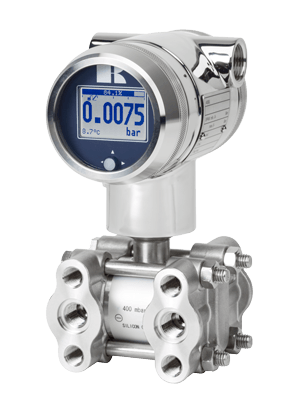
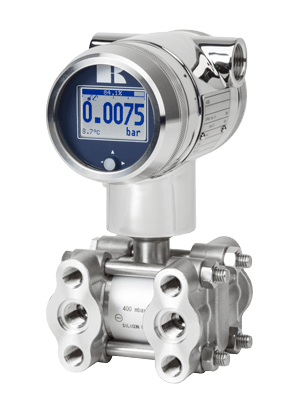
- Liquids and gases at high pressure and temperature: the primary element is a simple piece of metal in the line, and the transmitter sits on impulse lines, away from the process — the DP-4000 in our catalogue takes a static pressure of up to 160 bar (250 bar as an option)
- Large pipes and ducts, with an averaging pitot that goes in through a small hole: low cost and very little pressure loss
- Measurements that have to follow a standard: orifice plates, nozzles and venturi tubes to ISO 5167 are sized by calculation, and an orifice plate is easily swapped for a new flow range
- Combustion air and flue gas in ducts and furnaces, where the differential pressures are small — the D34 in our catalogue is made for combustion and airflow applications such as draft measurement
- Plants that already use differential pressure transmitters for pressure and level: the same instrument, the same spares and the same know-how for flow as well
Think twice when
- The flow range is wide: because of the square root, a 1:100 range in differential pressure covers only 1:10 in flow, and the bottom of the range is the least accurate
- Pumping or compression energy matters: an orifice plate leaves a permanent pressure loss — a venturi tube, or a technology with nothing in the pipe, loses far less
- The fluid is dirty or abrasive, or leaves deposits: solids collect at the plate or block the impulse lines, and a worn edge on the bore changes the reading without warning
- The liquid is very viscous, such as heavy fuel oil at low velocity: the relationship between Δp and flow stops being constant — a positive displacement or Coriolis flowmeter is usually the better fit
- There is little straight pipe: a differential pressure flowmeter typically needs 10–40 D upstream, more than most technologies
- You need the best possible accuracy: the overall accuracy depends on the primary element, its installation and the fluid data, not only on the transmitter — for liquids, a Coriolis flowmeter does better
How it compares with the other technologies
- Coriolis±0.1–0.2%
- Electromagnetic±0.2–0.5%
- Ultrasonic±0.5–2%
- Differential pressure (the technology of this article)±0.5–2%
- Variable area±1.6–4% *
- Vortex±0.75–2%
- Thermal mass±1–3%
- Positive displacement±0.2–0.5%
- Turbine±0.5–1%
Typical ranges for liquids (thermal mass: gases), ± % of the reading; for variable area, the accuracy class (*). The accuracy of a specific instrument depends on the model, the size and the installation — we confirm it for your application.
Installing a differential pressure flowmeter
The relationships of ISO 5167 hold only for a settled flow profile with no swirl, so the primary element needs straight pipe before and after it. How much depends on the element, on the diameter ratio β (bore to pipe) and on the fitting upstream: typically 10 to 40 D upstream and 5 D downstream (D = nominal diameter) — the most after two bends in different planes, a partly open valve or a large β. A venturi tube needs less than an orifice plate, and a flow conditioner can shorten the run.
The transmitter has to see the true pressures at the taps, so the impulse lines must not trap gas when measuring a liquid, or liquid when measuring a gas. Where the transmitter goes depends on the fluid: below the taps for liquids, above them for gases, and below them, with condensate pots, for steam. The lines should be as short as practical, slope continuously with no high or low points, and run side by side, so that both stay at the same temperature:
- Fit the orifice plate the right way round, with the sharp edge of the bore facing upstream (most plates are marked), centred in the pipe, and with gaskets that do not protrude into the pipe.
- Never open the equalising valve while both isolating valves are open: the fluid would flow through the manifold, and in steam service the condensate in the lines would be lost. Follow the manufacturer’s order for opening and closing the valves.
- In steam service, fill the lines and pots with water before start-up, so that steam never reaches the transmitter: the DP-4000 in our catalogue, for example, is rated for a process temperature of −20…+80 °C (+100 °C as an option).
- Take the square root once — in the transmitter or in the control system, not in both — and set the range of the transmitter to the maximum differential pressure of the primary element.
Differential pressure flowmeters by industry
Differential pressure transmitters we supply
The differential pressure transmitters in our catalogue — combined with an orifice plate, venturi tube, nozzle or pitot tube, they measure flow. The primary elements are not in our catalogue; this article describes them as part of the technology.
Differential pressure flowmeters: frequently asked questions
Ask about differential pressure flow measurement
Tell us the fluid (liquid, gas or steam), the pipe size, the flow range, the pressure and the temperature, and whether there is already a primary element in the line — and our engineers will suggest the right transmitter, with price and delivery time.