FLOW MEASUREMENT TECHNOLOGIES
Ultrasonic flowmeters: measuring liquids and gases with sound, with nothing in the flow path
An ultrasonic flowmeter sends pulses of sound through the fluid and works out the flow velocity from how long they take to cross the pipe. Nothing protrudes into the pipe and nothing moves, so there is no pressure loss and no wear — and, unlike an electromagnetic meter, it also measures liquids that do not conduct electricity, as well as gases. The range runs from in-line meters for process lines and large water mains, through multi-path meters for natural gas custody transfer, to clamp-on meters mounted on the outside of the pipe.
How an ultrasonic flowmeter works
Most industrial ultrasonic flowmeters use the transit-time method. Two transducers sit on opposite sides of the pipe, one further downstream than the other, so that the sound path between them crosses the flow at an angle. Each transducer both sends and receives: first a pulse travels from A to B, with the flow, then from B to A, against it.
Sound travelling with the flow arrives a little sooner; sound travelling against it arrives a little later. The difference between the two transit times, Δt, is proportional to the flow velocity along the path — twice the velocity, twice the difference. Because the transmitter uses both transit times, the speed of sound in the fluid cancels out of the calculation: the reading does not depend on it, even when the temperature or composition of the fluid changes it. The differences are tiny, so the electronics have to time them very precisely.
A single path measures the average velocity along one line, and the transmitter corrects it to the average over the whole cross-section using the expected flow profile. Meters with several paths sample more of the cross-section, so they are less affected by a distorted profile and reach higher accuracy — the ALTOSONIC V12 gas meter in our catalogue uses 12 paths. The average velocity multiplied by the cross-section gives the volume flow.
There are other ultrasonic methods too. Clamp-on meters work on the same transit-time principle, but their transducers are fixed to the outside of the pipe and the sound passes through the pipe wall. Doppler meters work differently: they need particles or bubbles in the liquid to reflect the sound, and measure the shift in its frequency — they suit dirty liquids, with lower accuracy. And in open channels, a non-contact ultrasonic sensor above the water measures the level upstream of a weir or flume, and the flow is calculated from that level.
- The liquid or gas flowing through the pipe
- Transducers A and B: each one sends a pulse and receives the other’s
- The sound path, diagonally across the pipe at an angle to the flow
- The two received pulses: the one sent with the flow (solid) arrives before the one sent against it (dashed); the gap between them is Δt
- The time difference Δt rises in proportion to the flow velocity v
Where an ultrasonic flowmeter fits — and where it does not
A strong choice for
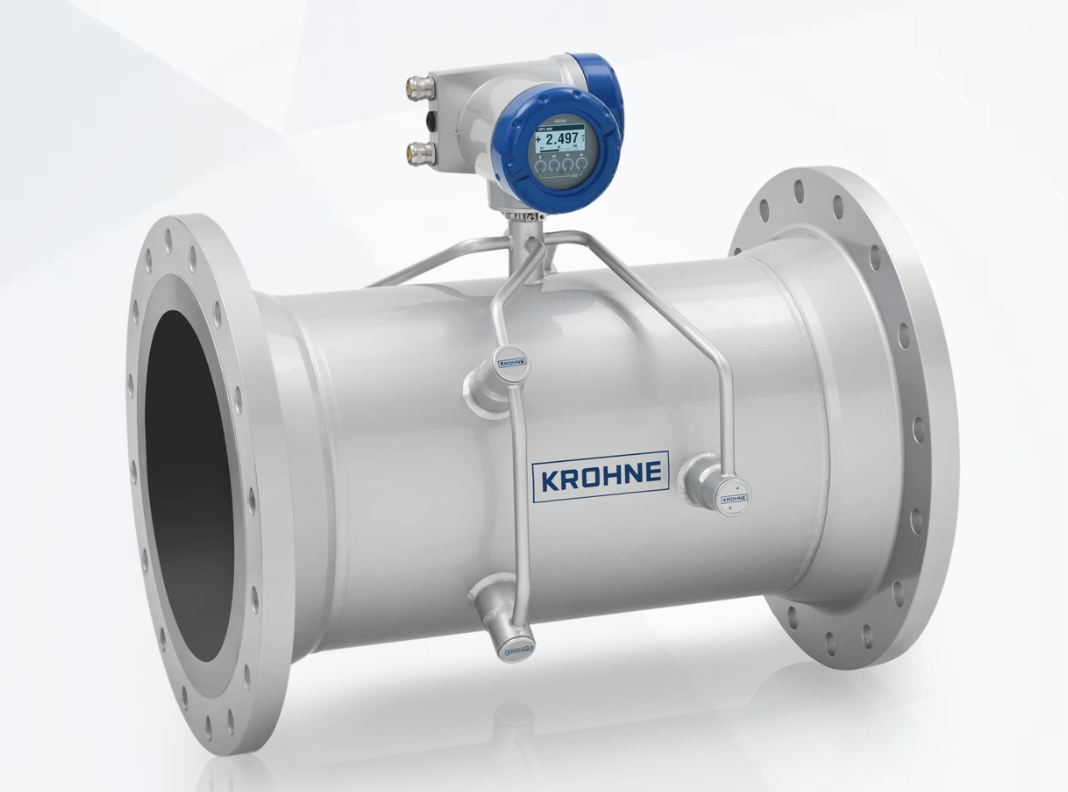
- Large water mains and pipelines: with nothing inside the pipe there is no pressure loss, and the OPTISONIC 3400 in our catalogue goes up to DN 4000
- Liquids that do not conduct electricity — oils, fuels, solvents, demineralised water — where an electromagnetic flowmeter cannot measure
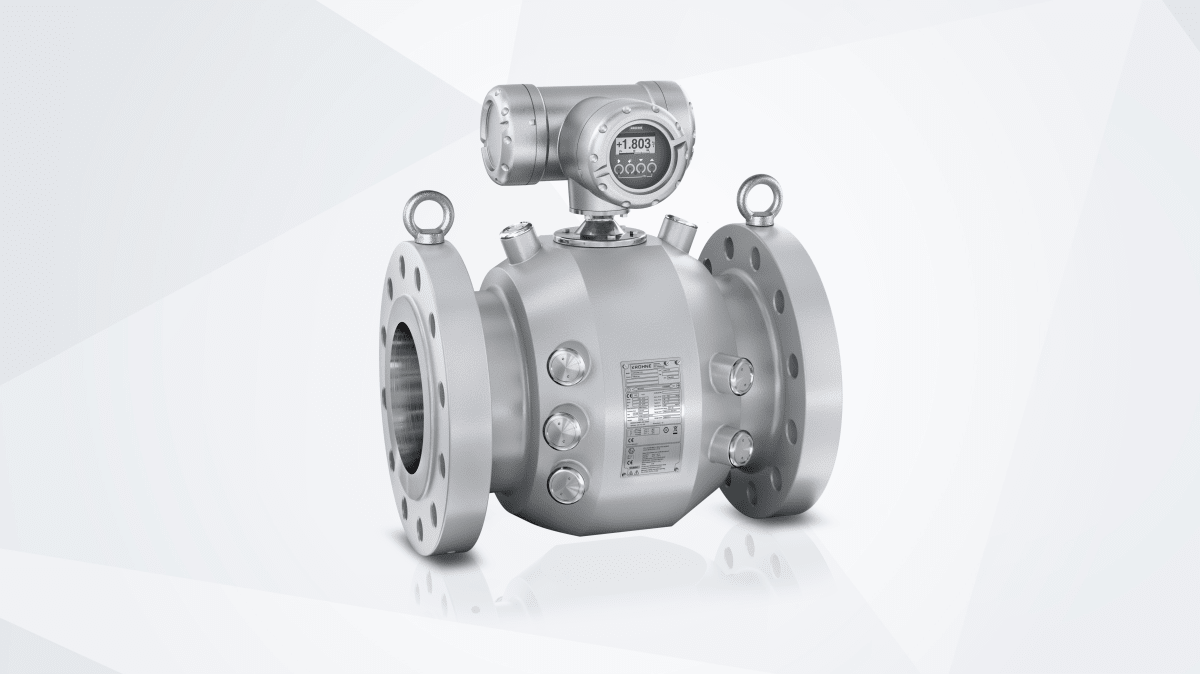
- Gases, including natural gas custody transfer, with multi-path meters such as the ALTOSONIC V12
- Clean or lightly contaminated process liquids in oil and gas, power and chemical plants
- Existing lines where the pipe cannot be cut or the process stopped: clamp-on versions mount on the outside — also for temporary or check measurements
- Open channels, wet wells and sumps, with a non-contact sensor above the water (DMSP900FH)
Think twice when
- The liquid carries a lot of gas bubbles or solids: they scatter and absorb the sound, and a transit-time meter can lose its signal
- There is little straight pipe after bends, pumps or valves: a distorted profile, or flow that swirls, misleads a meter with few paths
- The pipe may run partly full: an in-line meter assumes the whole cross-section is full. In open channels and sewers, flow is measured from the level instead
- You are measuring steam, or the process is very hot: the transducers set the limit — −40…+120 °C for the OPTISONIC 3400 in our catalogue, for example, and up to +175 °C for the ALTOSONIC V12
- The pipe is small: the sound path is short and the time difference tiny. The in-line ultrasonic meter in our catalogue starts at DN 25; for smaller lines an electromagnetic or Coriolis meter is usually the better fit
- You need mass flow: an ultrasonic flowmeter measures volume, so mass needs a known density — or a Coriolis flowmeter
How it compares with the other technologies
- Coriolis±0.1–0.2%
- Electromagnetic±0.2–0.5%
- Ultrasonic (the technology of this article)±0.5–2%
- Differential pressure±0.5–2%
- Variable area±1.6–4% *
- Vortex±0.75–2%
- Thermal mass±1–3%
- Positive displacement±0.2–0.5%
- Turbine±0.5–1%
Typical ranges for liquids (thermal mass: gases), ± % of the reading; for variable area, the accuracy class (*). The accuracy of a specific instrument depends on the model, the size and the installation — we confirm it for your application.
Installing an ultrasonic flowmeter
An ultrasonic flowmeter measures velocity along one or more lines, so it needs a settled flow profile. A typical requirement is 10 D of straight pipe upstream and 5 D downstream (D = nominal diameter) — more after two bends in different planes, a pump or a partly open valve, which set the flow swirling. Meters with more paths need less, and a flow conditioner can shorten the run; for each model, the manufacturer’s figure is what counts.
With liquids, the pipe must stay full and the sound path must stay clear of gas at the top of the pipe and of sediment at the bottom. Clamp-on meters add one more condition: the sound has to pass through the pipe wall, so the pipe material, wall thickness and inside diameter must be known. In open channels, the level is measured where the water is calm, upstream of the weir or flume:
- With liquids, install the meter where the pipe stays full: in a rising line or at a low point, never at the highest point of the line or in a downward line that may run empty.
- Fit control valves after the meter, and keep it away from sources of ultrasonic noise, such as partly closed valves and pressure-reducing stations, which can drown out the signal.
- For a clamp-on meter, pick a straight length of pipe in good condition: heavy scale, internal corrosion or a thick lining can weaken the signal, and any error in the inside diameter the transmitter assumes goes straight into the reading.
- In an open channel, mount the sensor on a rigid bracket, square to the water surface and clear of the walls, where the surface is calm and far enough upstream that it has not yet started to dip towards the weir — and high enough that the highest water level stays outside its blanking distance.
Ultrasonic flowmeters by industry
Ultrasonic flowmeters we supply
Ultrasonic instruments from our catalogue — for process liquids and large pipes, gas custody transfer, and non-contact level and flow measurement in open channels.
Ultrasonic flowmeters: frequently asked questions
Ask about ultrasonic flowmeters
Tell us the fluid (liquid or gas), the pipe size and material, the flow range, the pressure and the temperature — or, for an open channel, the type of weir or flume — and our engineers will suggest the right meter, with price and delivery time.