FLOW MEASUREMENT TECHNOLOGIES
Variable area flowmeters (rotameters): a simple local flow reading, with no power needed
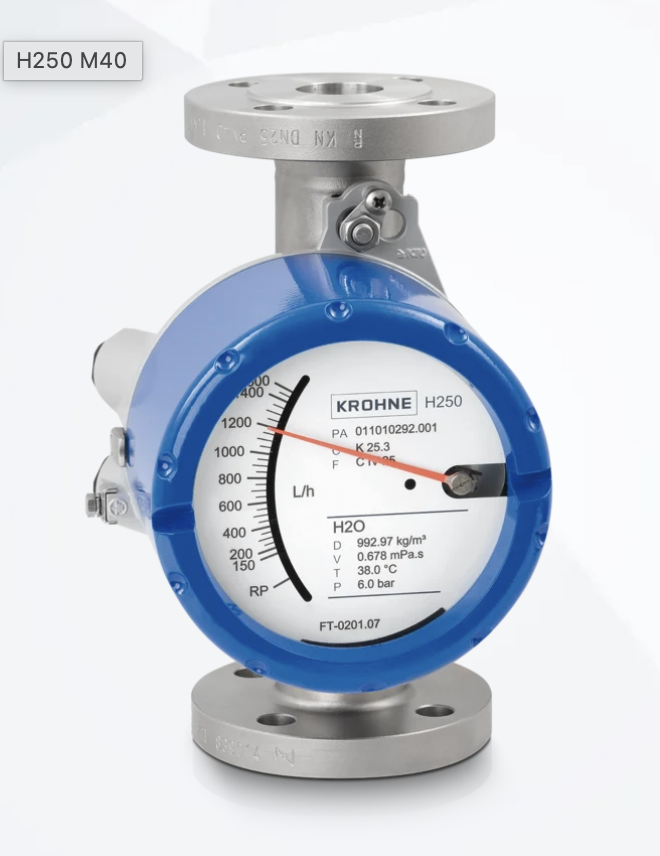
A variable area flowmeter, better known as a rotameter, has a float inside a vertical tapered tube. The flow lifts the float until it is balanced by its weight, and its height on a scale gives the flow rate. It is one of the simplest flowmeters: it needs no power, it shows the flow right at the pipe, and it suits small and medium flows of liquids and gases. In a glass-tube rotameter the float is seen directly; metal-tube versions, such as the H250 M40 in our catalogue, take higher pressures and temperatures, show the flow on a pointer through a magnetic coupling, and can also give a 4–20 mA signal.
How a variable area flowmeter works
The measuring tube stands vertically and widens towards the top, and inside it there is a float that is heavier than the fluid. The fluid enters from below and flows upwards, through the ring-shaped gap between the float and the tube wall. As it passes, it pushes the float upwards; the weight of the float, less the buoyancy of the fluid, pulls it down.
If the flow increases, the force on the float increases and the float rises. Higher up the tube is wider, so the gap grows and the fluid passes through it more slowly — until the upward force once again equals the weight and the float stops at a new height. Every flow rate therefore has its own float position, and the scale on or next to the tube shows the flow directly. Because the float always settles where the forces balance, the pressure drop across the meter stays almost the same over the whole range; what changes with the flow is the area the fluid passes through — hence the name.
The scale holds for the fluid it was made for: its density and viscosity, and for gases also the pressure and temperature inside the meter. With a different fluid or different operating conditions the reading changes and has to be converted, or the scale replaced. Accuracy is usually given as an accuracy class (for example class 1.6 to VDI/VDE 3513) rather than as a plain percentage of the reading, and the relative error is largest near the bottom of the scale. A typical rotameter covers a range of about 10:1.
In a glass (or plastic) tube the float is seen directly — a simple, inexpensive solution for low pressures and temperatures and for clear, non-hazardous fluids such as water and air. In a metal tube the float carries a magnet, and a second magnet in the indicator outside the tube follows it and turns a pointer over the scale. That is how the H250 M40 in our catalogue works: a local reading with no power and, as options, a 4–20 mA / HART transmitter and limit switches.
- The liquid or gas rising through the tube
- The tapered measuring tube: it widens towards the top
- The float, heavier than the fluid
- The ring-shaped gap between the float and the tube wall (orange): the higher the float, the larger the gap
- The forces on the float: the push of the flow upwards (orange) and its weight downwards; where they balance, the float stops
- The reading: the position of the float on the scale gives the flow rate
Where a variable area flowmeter fits — and where it does not
A strong choice for
- A local reading where there is no power, or none is needed: the meter works purely mechanically, and the operator sees the flow right at the pipe
- Small flows of liquids and gases: purge and blanketing gas such as nitrogen, cooling water to seals and bearings, sample lines to analysers, dosing of additives
- Setting and checking a flow by hand, together with a needle valve: the float shows at once whether the flow is where it should be
- Hot, corrosive or opaque fluids, with a metal tube and a magnetic indicator: the H250 M40 in our catalogue covers process temperatures from −40 to +300 °C, in sizes from DN15 to DN150
- Simple alarms without a control system: limit switches on the indicator give a signal when the flow falls too low or rises too high — for example, when the cooling water stops
- Low cost and little maintenance: a single moving part, and no electronics at all in the basic version
Think twice when
- The pipe is horizontal or the flow runs downwards: the usual designs need a vertical line with upward flow, because the float works against gravity — special versions exist, but they are the exception
- You need high accuracy or a measurement for billing: accuracy class 1.6 to 4 is fine for monitoring and setting a flow, not for custody transfer — a Coriolis or electromagnetic flowmeter does better
- The fluid, its viscosity or the operating conditions change: the scale holds for one density and viscosity, and for gases for one pressure and temperature; for very viscous liquids, a positive displacement or Coriolis flowmeter is usually the better fit
- The fluid is dirty or leaves deposits: they stick to the float and the tube and change the reading, and in a glass tube they hide the float; in a metal tube, iron particles collect on the magnet of the float
- The flow pulsates, as after a piston pump or compressor, or the gas is at low pressure: the float oscillates and the reading becomes unstable
- Steam: a metal-tube meter with a scale for the exact steam conditions can measure it, but a vortex or differential pressure flowmeter is the usual choice
How it compares with the other technologies
- Coriolis±0.1–0.2%
- Electromagnetic±0.2–0.5%
- Ultrasonic±0.5–2%
- Differential pressure±0.5–2%
- Variable area (the technology of this article)±1.6–4% *
- Vortex±0.75–2%
- Thermal mass±1–3%
- Positive displacement±0.2–0.5%
- Turbine±0.5–1%
Typical ranges for liquids (thermal mass: gases), ± % of the reading; for variable area, the accuracy class (*). The accuracy of a specific instrument depends on the model, the size and the installation — we confirm it for your application.
Installing a variable area flowmeter
A variable area flowmeter measures correctly only when it stands vertically — the float has to move freely along the axis of the tube — and when the flow runs from the bottom upwards. Mount it truly vertical, free of stress from the pipework, and support the pipe on both sides, especially when the measuring tube is glass. With a metal-tube meter, keep magnetic fields and steel parts away from the indicator, because they can pull the pointer.
A rotameter is less sensitive to the flow profile than most technologies, but it needs a calm, steady flow at its inlet: typically 5 D of straight pipe before it and 3 D after it (D = nominal diameter) — some manufacturers state that no straight run is needed. The control valve goes after the meter, not directly in front of it. With gases the meter also needs a steady pressure, because the reading depends on it:
- Flush the line before fitting the meter, so that welding residue and dirt do not reach the float; for fluids carrying iron particles, a magnetic filter in front of a metal-tube meter keeps them off the magnet of the float.
- Open the valves slowly: a sudden surge — especially with gases — throws the float against its upper stop and can damage it, or break a glass tube.
- Read the scale at the edge of the float that the manufacturer specifies, and check that the scale was made for your fluid and your operating conditions.
- If the meter has to come out for service without stopping the process, fit isolating valves before and after it and a bypass around it.
Variable area flowmeters by industry
The variable area flowmeter we supply
The variable area flowmeter in our catalogue: the Krohne H250 M40, with a metal tube, for liquids and gases. Glass-tube rotameters and purge meters are described in this article as part of the technology; they are not in our catalogue.
Variable area flowmeters: frequently asked questions
Ask about variable area flow measurement
Tell us the fluid (liquid or gas), the flow range, the pressure and temperature, the pipe size, and whether you need only a local reading or also a signal or an alarm — and our engineers will suggest the right meter, with price and delivery time.