TEMPERATURE MEASUREMENT TECHNOLOGIES
Pt100 resistance thermometers (RTDs): accurate, stable temperature measurement
A resistance thermometer, or RTD, measures temperature through the electrical resistance of a fine platinum element, which rises almost in a straight line as the temperature rises. The most common type, the Pt100, has a resistance of exactly 100 Ω at 0 °C. RTDs are the first choice for accurate and stable measurement in most process temperatures, from cryogenic up to about 600 °C. Our catalogue includes the Klay Instruments Pt100 sensors and the industrial RTDs of United Electric Controls.
How an RTD works
The electrical resistance of a metal rises with temperature, and platinum does so in a way that is very stable, repeatable and almost linear. A Pt100 element has 100 Ω at 0 °C and about 138.5 Ω at 100 °C — a rise of roughly 0.385 Ω for every degree. The relationship is defined by the international standard IEC 60751, so any Pt100 of the same class gives the same reading.
The element is either a fine platinum wire wound on a ceramic or glass core, or a thin platinum film on a ceramic chip. It sits at the tip of a metal sheath, often packed in ceramic powder, and the leads run up to the connection head. Many sensors offer two elements in one sheath (duplex), so that a second reading or a spare is always available.
To measure, the instrument passes a small, steady current through the element and measures the voltage across it; from the resistance it works out the temperature. The connecting leads also have resistance, which would add to the reading: that is why RTDs are connected with 2, 3 or 4 wires. With 3 wires the instrument compensates for the leads, and with 4 it eliminates their effect.
IEC 60751 defines tolerance classes. Class A allows ±0.15 °C at 0 °C and class B ±0.3 °C, and the tolerance widens as you move away from 0 °C. Tighter tolerances, such as 1/3 or 1/10 DIN, are fractions of class B: the Klay Pt100 is class B 1/3 DIN as standard, with 1/5 or 1/10 DIN as an option.
- The platinum element (orange coil) inside its ceramic body
- The heat of the process, which the element takes on
- The connecting leads — here four, two from each end of the element
- The instrument, which passes a small current and measures the resistance
- The resistance rises almost linearly with temperature: 100 Ω at 0 °C, about 138.5 Ω at 100 °C
Where an RTD fits — and where it does not
A strong choice for
- Accurate measurement from about −200 to +600 °C: the Klay Pt100 covers −50 to +200 °C or −200 to +400 °C
- Long-term stability: a platinum element drifts very little over years, so the reading can be trusted without frequent replacement
- Control loops and quality records in food, beverages and pharmaceuticals, with hygienic connections (EHEDG, 3-A) available
- Heat exchangers, boilers and energy metering, where small temperature differences matter
- A second element in the same sheath (duplex), for a backup reading or a separate safety signal
- Easy integration: a head-mounted transmitter turns the reading into 4–20 mA, HART, Profibus PA or IO-Link
Think twice when
- The temperature is above about 600 °C: a thermocouple is the usual choice there
- There is strong vibration or shock, as on engines and compressors: a wire-wound element can fail — ask for a vibration-resistant design, or use a thermocouple
- You need a very fast response at a single point: an RTD sheath is usually thicker than a thin thermocouple
- The sensor will be wired directly over a long distance with only 2 wires: the resistance of the leads adds to the reading
- You only need a contact at a set temperature: a temperature switch is simpler
How it compares with the other technologies
- RTDs (Pt100) (the technology of this article)−200…+600 °C
- Thermocouples−200…+1700 °C
- Temperature transmitters−200…+1700 °C *
- Temperature switches−50…+400 °C
Typical ranges, not a model commitment. RTD accuracy to IEC 60751 at 0 °C; thermocouple accuracy to IEC 60584, by type and class; for transmitters (*), the range is that of the sensor connected to them. We confirm the figures of each instrument for your application.
Installing an RTD
The element sits at the tip of the sheath, so the tip must reach the part of the process whose temperature you want, and enough of the sheath must be immersed that heat conducted along it from outside does not distort the reading. In most pipes that means reaching well into the flow; in a small pipe, an elbow gives more length.
In most process lines the sensor goes into a thermowell, so that it can be removed without opening the line. Then:
- Make sure the sensor touches the bottom of the thermowell bore, so that heat reaches the element quickly.
- Keep the connection head away from strong heat sources, and within its ambient range — for the Klay Pt100 head, −20 to +70 °C.
- Use 3- or 4-wire connection for any run longer than a few metres, or fit a head-mounted transmitter.
- Avoid points with strong vibration, or ask for a design rated for it.
RTDs by industry
RTDs in our catalogue
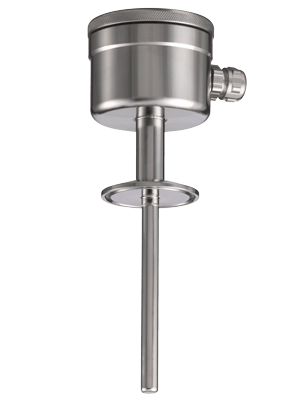
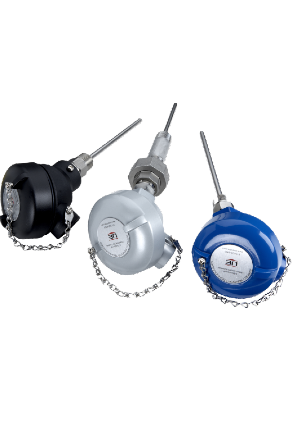
The resistance thermometers in our catalogue, each with its own page and technical data.
RTDs: frequently asked questions
Ask about an RTD
Tell us the medium, the temperature range, the process connection and immersion length, the accuracy class and the output you need — and our engineers will suggest the right sensor, with price and delivery time.