LEVEL MEASUREMENT TECHNOLOGIES
Floats and displacers: level switches and level transmitters that use buoyancy
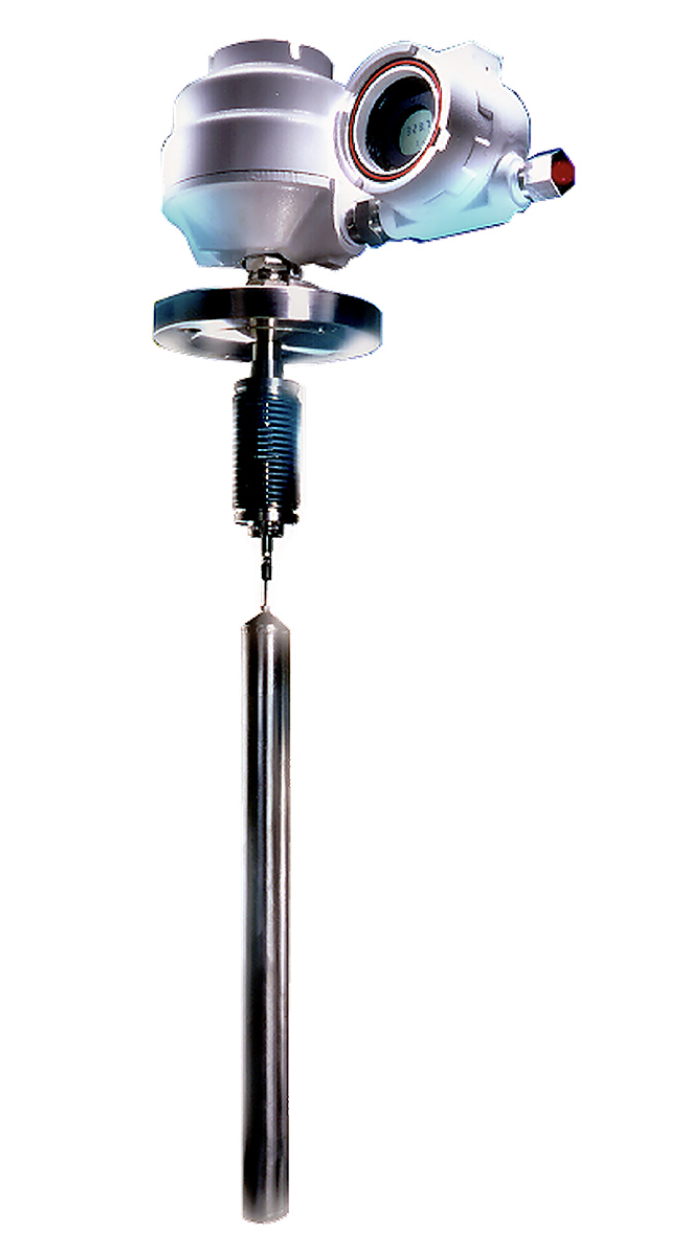
Floats and displacers measure level with buoyancy — a simple, proven principle that is still the right one for many jobs. A float switch gives a simple, robust level alarm; a displacer transmitter gives the level, or the interface between two liquids, at high temperature and pressure. Our catalogue includes the Delta Mobrey horizontal magnetic float switches and the Mobrey MLT100 displacer level transmitter.
How floats and displacers work
A float is lighter than the liquid and rides on its surface. On a horizontal float switch, the float sits on an arm through the tank wall; when the level reaches it, the float rises and a magnet operates a contact outside the liquid. The Delta Mobrey horizontal magnetic float switches use this magnetic actuation for level alarms and control.
A displacer is heavier than the liquid and does not float. It hangs from a spring or a torque element, and as the liquid rises around it, it is lifted by a force equal to the weight of the liquid it displaces — the principle of Archimedes. Its apparent weight falls in proportion to the level, and the transmitter turns that change into a continuous signal.
The Mobrey MLT100 combines this buoyancy principle with LVDT-based electronics and HART. It works from −60 to +320 °C and from full vacuum to 200 bar, for liquids with a specific gravity from 0.5 to 1.5; it mounts directly on the vessel or in an external chamber, and carries ATEX Ex db approval.
Because buoyancy depends on density, a displacer can also measure an interface: fully submerged, it reads where the heavier liquid ends and the lighter one begins. The MLT100 measures interfaces with a specific gravity difference as low as 0.1.
- The float, riding on the surface of the liquid
- The contact of the float switch, changing state as the float rises
- On the displacer: its weight (down) and the buoyancy of the liquid (up)
- The signal of the displacer transmitter rises in a straight line with the level
Where floats and displacers fit — and where they do not
A strong choice for
- Simple high and low level alarms in tanks, with float switches
- Level and interface in separators, knock-out pots and condensate drums
- High temperature and pressure: the MLT100 works up to +320 °C and 200 bar
- External chambers that can be isolated for maintenance without opening the vessel
- Clean liquids of known, steady density
Think twice when
- The liquid is dirty, sticky or crystallising, and would clog the float or coat the displacer
- The density of the liquid changes: the displacer reads it as a change of level
- The surface is turbulent or foaming and keeps a float moving
- The medium is a powder or a bulk solid: there is no buoyancy
How it compares with the other technologies
- Hydrostatic level transmitters−20…+100 °C
- Radar level−40…+200 °C
- Ultrasonic level−40…+80 °C
- Vibrating level switches−40…+120 °C
- Floats and displacers (the technology of this article)−60…+320 °C
- Conductive and HF level switches−30…+150 °C
- Rotating paddle−20…+80 °C
Typical process temperatures, not a model commitment; several technologies have versions for higher temperatures. We confirm the figures of each instrument for your application.
Installing floats and displacers
A displacer can hang directly in the vessel, in a stilling well, or in an external chamber connected to the vessel at the top and the bottom. A chamber with isolating valves lets you service the transmitter without emptying the vessel.
Then:
- Give us the densities of the liquids at operating temperature: the displacer is sized and set up for them.
- Keep the chamber connections clear of deposits, and drain the chamber when you service it.
- Mount a float switch where the surface is calm, away from the inlet.
- After installation, check that the float or the displacer moves freely.
Floats and displacers by industry
Floats and displacers in our catalogue
The float switches and displacer transmitters in our catalogue, each with its own page and technical data.
Floats and displacers: frequently asked questions
Ask about a float switch or a displacer
Tell us the liquid and its density, the vessel, whether you need an alarm, the level or an interface, the process temperature and pressure, and the connection — and our engineers will suggest the right instrument, with price and delivery time.