LEVEL MEASUREMENT TECHNOLOGIES
Conductive and HF level switches: electronic point level with no moving parts
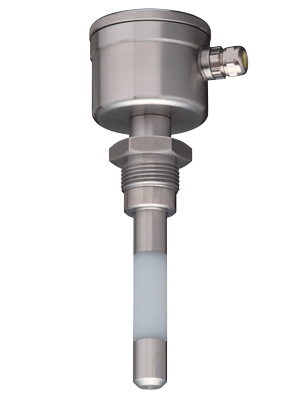
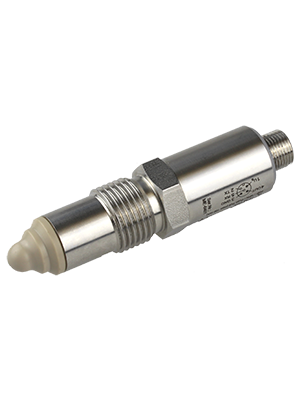
Conductive and HF level switches detect whether a liquid or a paste has reached a point, with a simple electronic probe and no moving parts. A conductive switch is the simplest choice for water-based liquids; an HF switch works in a wider range of media and suits compact, hygienic installations. Our catalogue includes the Klay FLX conductive switch and the KMW HF switch. It also includes the compact KMW-LC, for hygienic installations.
How conductive and HF level switches work
A conductive switch has an electrode insulated from its housing. When a conductive liquid touches it, a small alternating current flows from the electrode, through the liquid, to the metal tank wall or a second electrode, and the electronics switch the output. The Klay FLX works this way, for conductive liquids, with insertion lengths from 20 mm to 2 m and a flush version, adjustable sensitivity, and a relay or PNP output.
An HF switch creates a high-frequency electrical field at its tip. Air, liquids and pastes change that field in different ways, and the electronics compare the change with a sensitivity set for the medium. The Klay KMW is an HF switch for liquids and viscous media, with its sensitivity set by dip-switch or PC, EHEDG-compliant connections, and a 25 mm tip for viscous media.
Both are point-level switches: they say whether the medium is at the tip, not where the level is. For continuous level, use a level transmitter.
- Conductive switch: the electrode and the metal tank wall, the two poles of the measuring circuit
- The small current that flows through the liquid once it touches the electrode
- HF switch: the high-frequency field at the tip, which the medium changes
- The electronics, which compare the change with the set sensitivity
- The output, which changes state when the medium reaches the probe
Where conductive and HF switches fit — and where they do not
A strong choice for
- Simple high and low limits in water and other conductive liquids, with a conductive switch
- Pump control between two switches, high and low
- Liquids, viscous media and pastes in food, beverage and pharmaceutical processes, with an HF switch
- Hygienic installation, with small probes on hygienic connections
- Small tanks and pipes, where there is no room for a fork
Think twice when
- The liquid does not conduct — oils, solvents, fuels: a conductive switch cannot see it
- You need the level itself: these switches give a limit only
- The medium is a bulk solid: use a vibrating rod or a rotating paddle
- Heavy build-up could bridge a conductive electrode to the wall and keep the switch on after the level falls
How it compares with the other technologies
- Hydrostatic level transmitters−20…+100 °C
- Radar level−40…+200 °C
- Ultrasonic level−40…+80 °C
- Vibrating level switches−40…+120 °C
- Floats and displacers−60…+320 °C
- Conductive and HF level switches (the technology of this article)−30…+150 °C
- Rotating paddle−20…+80 °C
Typical process temperatures, not a model commitment; several technologies have versions for higher temperatures. We confirm the figures of each instrument for your application.
Installing conductive and HF level switches
Mount the probe at the level you want to detect, through the wall or from the top. A conductive switch needs a conductive tank wall or a second electrode as its other pole; in a plastic tank, use a second electrode.
Then:
- Set the sensitivity for the medium at commissioning, and check it with the medium present.
- Mount the probe where the medium drains off it when the level falls.
- Keep a conductive electrode insulated from the wall along its length, except at the tip.
- Choose the output for the control system: relay, PNP or NPN.
Conductive and HF level switches by industry
Conductive and HF level switches in our catalogue
The conductive and HF level switches in our catalogue, each with its own page and technical data.
Conductive and HF level switches: frequently asked questions
Ask about a conductive or HF level switch
Tell us the medium and whether it conducts, the function (high, low, pump control), the process temperature and pressure, the connection and the output you need — and our engineers will suggest the right switch, with price and delivery time.