LEVEL MEASUREMENT TECHNOLOGIES
Vibrating level switches: tuning forks and rods for liquids and solids
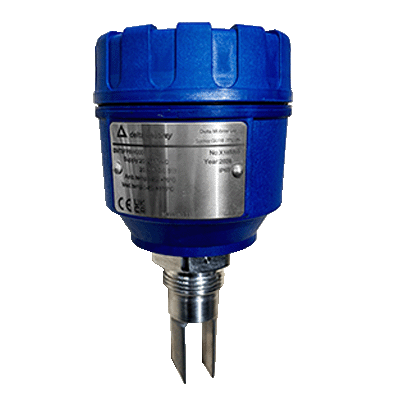
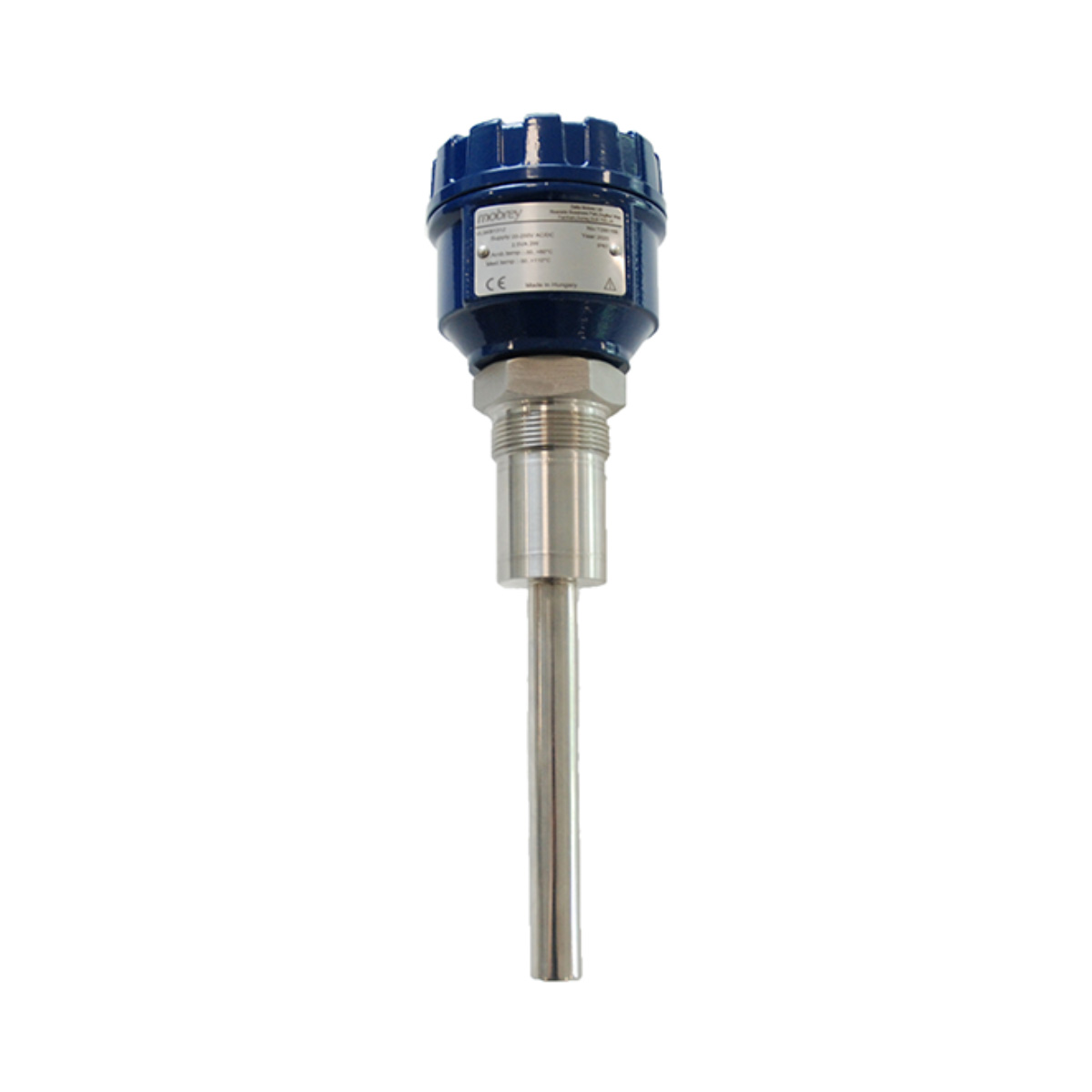
A vibrating level switch tells you whether a liquid or a powder has reached a point — for overfill and dry-run protection, and for high and low alarms in tanks and silos. It has no moving parts that wear, and works in liquids, powders and granules. Our catalogue includes the Klay Vibraswitch-C and Vibraswitch-S tuning forks for liquids, the Delta Mobrey DMS & DMT forks for liquids and solids, and the Delta Mobrey VLS vibrating rod for bulk solids.
How a vibrating level switch works
A drive in the switch, usually piezoelectric, keeps a fork or a rod vibrating at its resonant frequency. In air it vibrates freely. When a liquid or a powder covers it, the medium damps the vibration and lowers its frequency; the electronics detect the change and switch the output.
The Delta Mobrey DMS & DMT, for example, keep the fork in resonance with an electronic circuit, detect the damping when material touches it, and switch the output relay after a configurable delay — so that splashes and falling powder do not cause false alarms.
The Klay Vibraswitch-C and -S are tuning forks for liquids, with viscosities up to 10,000 cSt, process temperatures from −40 °C up to +100 °C (C) or +120 °C (S), pressures up to 40 bar, and insertion lengths from 47 mm to 3 m. The Delta Mobrey VLS uses a vibrating rod for powders, granules and other free-flowing solids, with an LED that shows the switch state.
- The vibration of the fork at its resonant frequency, in air
- The electronics, which keep the fork in resonance and detect the change
- The switch point: the level at the tines of the fork
- The level, rising towards the switch point
- The output, which changes state when the medium covers the fork
Where a vibrating level switch fits — and where it does not
A strong choice for
- Overfill protection on storage and process tanks
- Dry-run protection for pumps, in the tank or in the suction pipe
- High and low level in silos of powders and granules
- Liquids of very different kinds, including viscous ones — up to 10,000 cSt on the Vibraswitch
- Hygienic tanks, with smooth wetted parts and hygienic connections, as on the Vibraswitch
Think twice when
- You need the level itself, not a limit: use a level transmitter
- The medium leaves heavy, hard build-up that bridges the tines
- Large lumps or falling material could hit the fork: protect it with a baffle, or choose a rod
- The switch would sit in the filling stream, where splashes cover it
How it compares with the other technologies
- Hydrostatic level transmitters−20…+100 °C
- Radar level−40…+200 °C
- Ultrasonic level−40…+80 °C
- Vibrating level switches (the technology of this article)−40…+120 °C
- Floats and displacers−60…+320 °C
- Conductive and HF level switches−30…+150 °C
- Rotating paddle−20…+80 °C
Typical process temperatures, not a model commitment; several technologies have versions for higher temperatures. We confirm the figures of each instrument for your application.
Installing a vibrating level switch
Mount the switch at the level you want to detect: near the top for overfill, near the bottom or in the pump suction for dry-run. In liquids, a fork through the side wall is usually mounted horizontally, with its tines turned so that the liquid drains between them.
Then:
- Keep the tines away from the inlet stream and the wall, and out of nozzles where product can stay between them.
- In silos, protect a rod or a fork from falling material with a baffle above it.
- Choose the switching mode for the function, so that the output goes to the safe state if the power fails.
- Test the switch periodically by covering the fork, or with the test function where the electronics have one.
Vibrating level switches by industry
Vibrating level switches in our catalogue
The vibrating level switches in our catalogue, each with its own page and technical data.
Vibrating level switches: frequently asked questions
Ask about a vibrating level switch
Tell us the medium, the function (overfill, dry-run, high or low level), the process temperature and pressure, the connection and the output you need — and our engineers will suggest the right switch, with price and delivery time.